Content Syndication for ABM in 2026: 6 Strategic Shifts Driving Revenue, Not Just Leads
For years, content syndication was evaluated through a single lens: the number of leads generated.
That approach no longer reflects the realities of 2026.
Today’s leading B2B organizations view syndication not as a volume-based lead engine, but as a strategic, account-level engagement mechanism designed to influence pipeline progression and revenue outcomes. As explored in 6 Content Syndication Trends Shaping B2B ABM in 2026, shifting buyer behaviors, AI-powered discovery models, and increasingly complex buying committees have redefined what meaningful performance looks like.
In a zero-click landscape where multiple stakeholders shape decisions behind the scenes, syndication must be orchestrated, transparent, and tightly aligned to revenue impact.
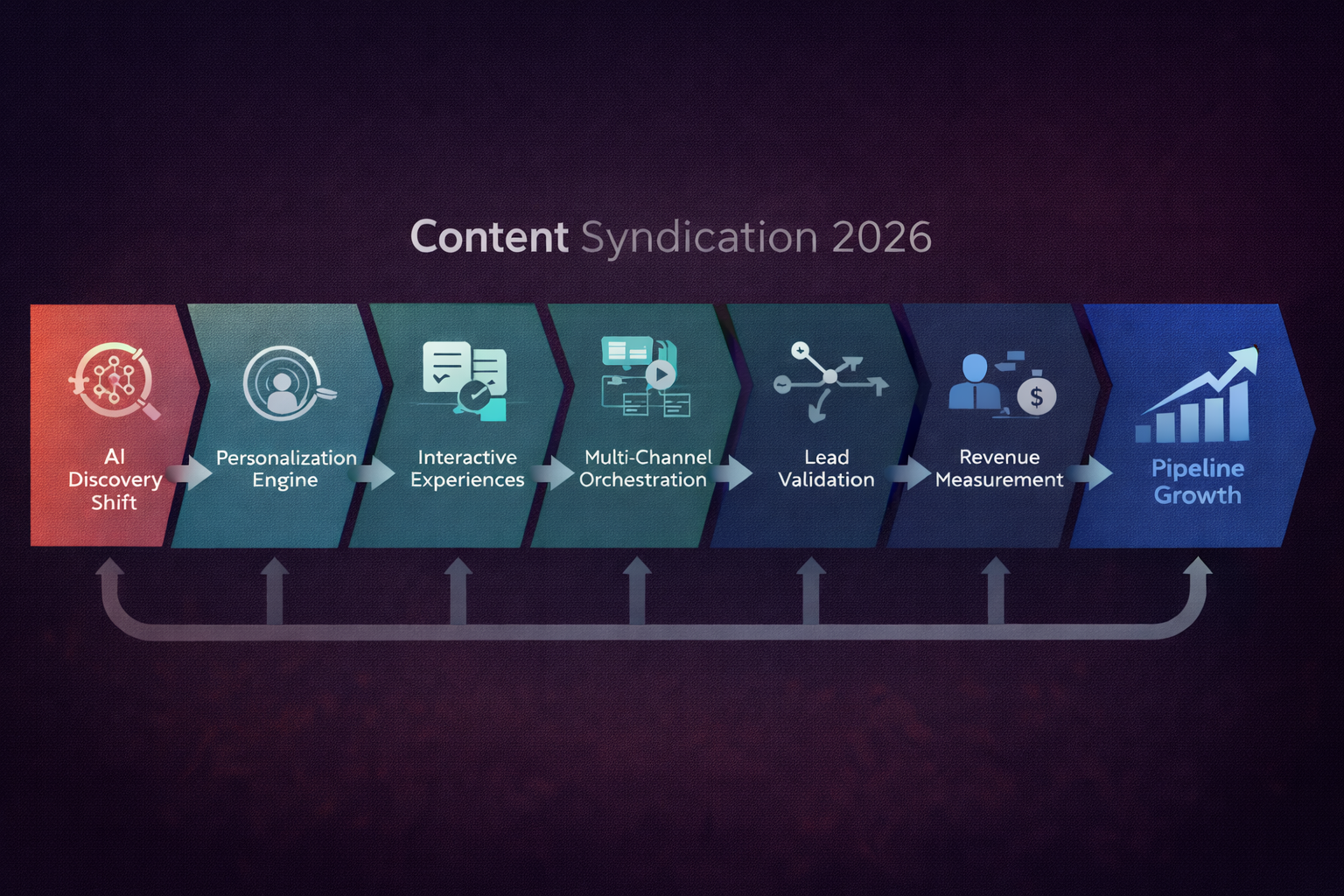
What follows is a strategic analysis of the six forces transforming content syndication into a core pillar of modern account-based marketing (ABM).
1. AI and Zero-Click Search Are Disrupting Traditional Discovery
Search behavior has changed.
Buyers increasingly get answers directly from AI summaries, search engine results pages, and conversational interfaces without ever clicking through to brand websites. While convenient for buyers, this reduces marketers’ control over visibility and engagement tracking.
Organic inbound alone is no longer predictable.
Content syndication counterbalances this shift by placing assets directly within trusted B2B media ecosystems and professional environments where buyers already consume information.
Unlike traditional SEO-driven visibility, syndication:
Guarantees exposure among target accounts
Captures authenticated engagement data
Creates measurable touchpoints that can be orchestrated across channels
In an AI-mediated discovery landscape, syndication becomes a visibility strategy — not just a lead tactic.
2. AI-Powered Personalization Is Now the Baseline
Broad, generic distribution no longer performs.
Advanced syndication programs now leverage AI and intent data to personalize content delivery across buying committees. Instead of pushing the same asset to every prospect, algorithms align content with:
Role-based priorities
Industry-specific challenges
Buying stage indicators
Behavioral engagement signals
For example:
CFOs receive financial impact analyses
IT leaders receive implementation guides
Operations stakeholders see efficiency-focused case studies
This precision transforms syndication into a role-aligned ABM lever rather than a mass distribution tool.
Personalization is no longer a competitive advantage. It is table stakes.
3. Interactive Formats Are Replacing Static PDFs
Traditional gated PDFs are losing momentum.
In an attention-scarce environment, interactive formats outperform static assets because they generate deeper engagement and richer first-party signals.
High-performing formats now include:
ROI calculators
Assessment tools and maturity models
Interactive product walkthroughs
Micro-learning video content
Modular webinar segments
These experiences create two-way engagement. Instead of simply collecting an email address, marketers gather behavioral insights that reveal readiness and priority areas.
When a prospect spends 10 minutes completing an assessment tool, that signal is far stronger than a passive download.
Syndication is evolving from document distribution to experience distribution.
4. Multi-Channel Orchestration Is No Longer Optional
Siloed syndication campaigns underperform.
Modern ABM programs treat syndication as one component within a coordinated, multi-channel system that includes:
Display advertising
Paid social (including LinkedIn ABM targeting)
Retargeting
Sales outreach
Email nurture sequences
When a target account engages with syndicated content, that signal should trigger coordinated reinforcement:
Relevant display ads
Context-aware sales messaging
Expanded buying committee targeting
Follow-up content distribution
Orchestration ensures momentum rather than fragmentation.
Disconnected touchpoints dilute influence. Coordinated activation accelerates it.
5. Lead Validation and Transparency Are Non-Negotiable
Lead quality has overtaken lead volume as the primary success metric.
Marketing and revenue leaders now demand transparency around:
Data sourcing
Contact validation
ICP alignment scoring
Engagement authentication
Content placement visibility
Unverified or low-intent leads erode trust between marketing and sales.
Modern syndication must function as a trust contract — delivering validated, ICP-aligned contacts that demonstrate genuine engagement.
Transparency is not an operational detail. It is a strategic requirement.
6. Full-Funnel Measurement Is Replacing Lead-Centric Metrics
Traditional metrics like CPL and MQL counts provide limited insight into revenue impact.
In ABM-driven organizations, syndication success is measured through:
Account engagement depth
Buying committee coverage
Pipeline velocity
Opportunity progression
Revenue attribution
Win-rate correlation
The key shift is from contact-level measurement to account-level influence.
A syndication program that reaches multiple stakeholders within a target account and accelerates deal progression is far more valuable than one that generates isolated form fills.
Revenue alignment defines modern syndication performance.
From Lead Engine to Revenue Infrastructure
Content syndication in 2026 is not about scaling downloads. It is about shaping buying committee momentum.
When integrated properly, syndication:
Reinforces awareness in zero-click environments
Personalizes messaging across roles
Delivers interactive engagement
Coordinates cross-channel orchestration
Provides validated, transparent data
Influences measurable pipeline outcomes
The future belongs to marketers who treat syndication as strategic infrastructure — not a line item.
If your organization is still evaluating syndication primarily through volume metrics, it may be time to realign.
Our team partners with B2B organizations to design AI-powered, revenue-focused syndication programs integrated directly into ABM frameworks.
Let’s explore how your content distribution strategy can evolve from lead generation to revenue acceleration.
FAQs
Yes. Syndication ensures content appears directly within trusted professional environments, reducing reliance on organic clicks.
AI aligns content with role-specific needs, buying stage signals, and behavioral patterns to increase engagement relevance.
Focus on account penetration, pipeline velocity, buying committee engagement, and revenue attribution — not just CPL or MQL volume.
In many cases, yes. Interactive content generates stronger engagement signals and deeper behavioral insights.
Syndication signals can trigger coordinated display, social, and sales outreach, reinforcing influence across buying committees.
Recent Blogs
-

Predictive Buying Stage Intelligence: Aligning Sales and Marketing for Smarter B2B Revenue Growth
-

Measuring B2B Marketing Performance in an AI-Driven, Zero-Click Landscape
-
Dark Social in B2B Marketing: Turning Invisible Engagement into ABM Pipeline Growth
-
Content Syndication for ABM in 2026: 6 Strategic Shifts Driving Revenue, Not Just Leads
Get the Right Solution You Need from Our Expert Team Today
Quick, reliable support tailored to you.