Predictive Buying Stage Intelligence: Aligning Sales and Marketing for Smarter B2B Revenue Growth
In most B2B organizations, stalled revenue isn’t the result of insufficient activity — it’s the consequence of disconnected execution.
Marketing is generating interest. Sales is initiating outreach. But without a unified, real-time view of buyer readiness, both teams are operating on assumptions rather than aligned insight.
The outcome is predictable:
Sales engages before the account is prepared to respond.
Marketing continues nurturing long after buying intent has matured.
Promising opportunities lose traction at critical inflection points.
As discussed in Unlock True Sales and Marketing Alignment with ML Predictive Buying Stage, sustainable alignment doesn’t emerge from additional reporting layers or more frequent status meetings. It comes from a shared, data-driven understanding of where each account stands within the buying journey.
Predictive buying stage intelligence bridges this gap by converting fragmented engagement signals into clear, actionable visibility — allowing revenue teams to coordinate timing, messaging, and outreach with precision.
The Root Cause of Misalignment: Timing and Context
Sales and marketing misalignment often stems from one question:
“Is this account ready?”
Marketing may see rising engagement. Sales may see silence. Without contextual signals tied to buying stages, prioritization becomes guesswork.
This challenge is compounded by modern B2B buying behavior:
Buyers conduct extensive self-guided research before engaging sales.
Multiple stakeholders influence decisions across departments.
Purchase journeys span weeks or months.
When timing is off by even a few weeks, opportunities stall.
Revenue acceleration requires precision.
From Raw Engagement to Buying Stage Intelligence
Predictive buying stage models convert fragmented signals into structured insight.
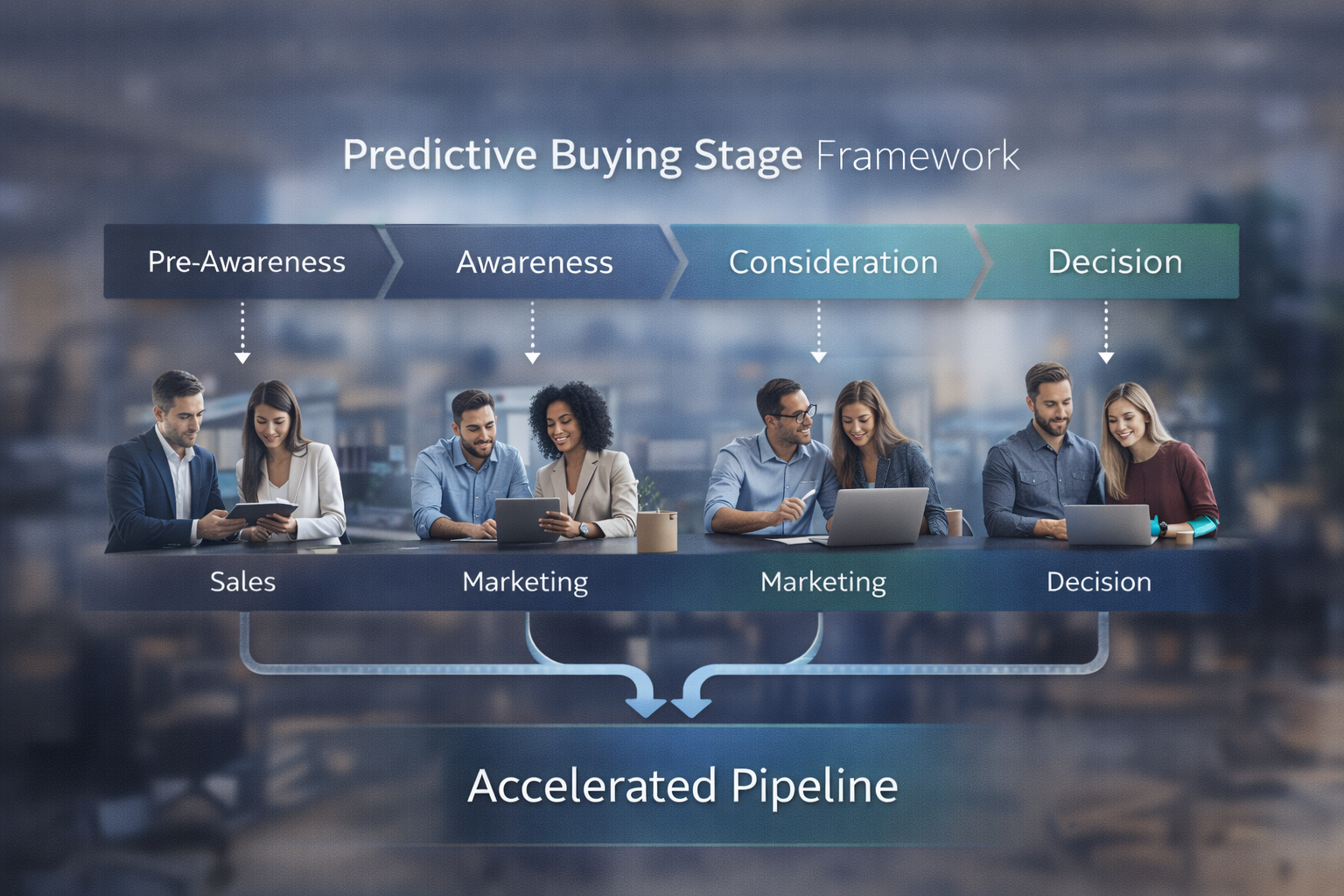
Rather than viewing engagement as isolated events (clicks, downloads, impressions), advanced systems classify accounts into defined buying stages, such as:
Pre-Awareness
Awareness
Consideration
Decision
This classification provides a shared, dynamic source of truth across teams.
Why This Matters
When both marketing and sales see the same buying stage classification:
Sales knows which accounts merit immediate outreach.
Marketing knows which accounts require continued nurturing.
Handoffs occur with precision rather than assumption.
Buying stage intelligence replaces intuition with data-backed timing.
Prioritization That Drives Pipeline Velocity
Traditional lead scoring focuses on individual contacts. Predictive buying stage intelligence focuses on accounts.
This shift is critical in ABM-driven environments.
When accounts enter late-stage research:
Sales can prioritize outreach to capitalize on active evaluation.
Messaging can shift from education to differentiation.
Sales cycles compress due to improved timing.
Conversely, early-stage accounts can remain within nurture flows until intent strengthens.
This reduces wasted effort and increases conversation quality.
Prioritization becomes strategic, not reactive.
Understanding the Full Buying Committee
Modern B2B purchases involve diverse stakeholders — each with unique priorities:
Finance evaluates ROI.
IT assesses implementation feasibility.
Operations focuses on efficiency impact.
Executives evaluate strategic alignment.
Predictive buying stage intelligence does more than classify accounts. It reveals:
Which personas are actively researching
How engagement spreads across the buying group
Whether activity is concentrated or multi-threaded
When engagement expands across departments, buying momentum strengthens.
Sales teams can then tailor outreach by persona, increasing credibility and response rates.
Personalization at Scale, Powered by Context
Personalization often fails because it lacks behavioral grounding.
Predictive buying stage intelligence enables messaging aligned to:
Stage of evaluation
Specific content consumed
Identified research themes
Observed engagement patterns
For example:
Awareness-stage accounts receive thought leadership and industry benchmarks.
Consideration-stage accounts receive product comparisons and case studies.
Decision-stage accounts receive pricing frameworks and executive briefs.
This contextual alignment elevates messaging relevance without requiring manual analysis for every account.
Scaling personalization becomes feasible — and impactful.
Integrating Predictive Signals into Sales Workflows
Insight without action is inefficiency.
To drive performance, predictive buying stage data must integrate seamlessly into existing sales workflows.
This includes:
CRM visibility
Sales intelligence platforms
Conversation intelligence tools
AI-assisted outreach platforms
When buying stage data is embedded directly within sales systems, reps can:
Prioritize accounts instantly
Craft relevant messaging
Avoid premature outreach
Engage during optimal windows
Efficiency improves. Friction decreases. Momentum increases.
The Revenue Impact of True Alignment
When predictive buying stage intelligence is operationalized effectively, organizations see measurable benefits:
Higher sales productivity
Reduced time spent on unqualified accounts
Improved conversion rates
Faster pipeline velocity
Greater win-rate consistency
Most importantly, sales and marketing begin operating as a synchronized revenue engine rather than separate functions.
Shared intelligence fosters shared accountability.
From Fragmented Signals to Unified Strategy
Predictive buying stage intelligence reframes how revenue teams think about engagement.
Instead of asking:
“Who downloaded our whitepaper?”
Teams ask:
“Which accounts are advancing toward a buying decision?”
Instead of debating:
“Is marketing sending enough leads?”
Teams align around:
“Are we engaging the right accounts at the right stage?”
This mindset shift is transformational.
Revenue acceleration does not require more noise. It requires more clarity.
Designing a Stage-Based Go-to-Market Strategy
To implement predictive buying stage alignment effectively:
Define clear buying stages aligned to your industry and sales cycle.
Unify engagement data across channels — paid media, content syndication, email, and web activity.
Operationalize stage visibility within CRM and sales workflows.
Align messaging and nurture tracks to stage-specific needs.
Measure pipeline velocity and win rates by stage movement.
This approach transforms buying stage data from a reporting metric into a strategic lever.
Clarity. Focus. Confidence.
At its core, predictive buying stage intelligence delivers three outcomes revenue teams have long pursued:
Clarity – A shared understanding of buyer readiness.
Focus – Prioritization aligned to real momentum.
Confidence – Outreach backed by behavioral evidence.
In competitive B2B markets, these advantages compound.
Organizations that synchronize sales and marketing around stage-based intelligence outperform those relying on fragmented engagement metrics.
If your teams are still operating without unified visibility into buyer readiness, the opportunity for alignment — and revenue acceleration — may be significant.
Our team helps B2B organizations implement predictive buying stage frameworks that unify engagement data, empower sales teams, and drive measurable pipeline growth.
Let’s explore how your go-to-market motion can evolve from reactive to predictive.
FAQs
It is a data-driven approach that classifies target accounts into buying stages based on engagement and intent signals.
It enables sales teams to prioritize outreach based on readiness, improving timing, response rates, and pipeline velocity.
Because B2B decisions involve multiple stakeholders. Account-level insights reflect collective momentum rather than individual activity.
Marketing can allocate budget toward accounts in high-conversion stages and optimize nurturing for earlier-stage prospects.
Improved win rates, reduced sales cycle length, increased multi-threaded engagement, and stronger pipeline progression.
Recent Blogs
-
Predictive Buying Stage Intelligence: Aligning Sales and Marketing for Smarter B2B Revenue Growth
-
Measuring B2B Marketing Performance in an AI-Driven, Zero-Click Landscape
-
Dark Social in B2B Marketing: Turning Invisible Engagement into ABM Pipeline Growth
-
Content Syndication for ABM in 2026: 6 Strategic Shifts Driving Revenue, Not Just Leads
Get the Right Solution You Need from Our Expert Team Today
Quick, reliable support tailored to you.